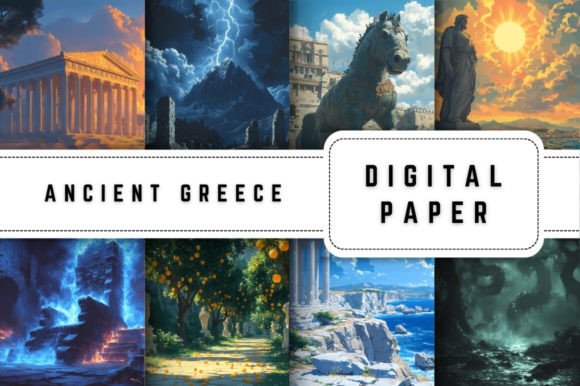
Timeless Patterns: Ancient Greece Digital Paper Backgrounds
When you work in design, you develop a library of textures and patterns that you instinctively reach for when a project needs depth. You have your go-to grunge textures for urban brands and soft watercolors for wedding invitations. But when the brief calls for history, legacy, and a sense of permanence, generic textures often fall short. This is where Ancient Greece Digital Paper Backgrounds enter the conversation. These aren't just random images of ruins; they are carefully curated collections of historical motifs that bring the architectural and artistic mastery of the classical world into your digital workflow.
The Visual Language of the Classics
To understand the value of these design assets, we have to look beyond the surface. Ancient Greece Digital Paper Backgrounds are defined by their geometric precision and organic storytelling. You will typically find intricate meanders (the Greek Key pattern), which symbolize infinity and the eternal flow of life. Alongside these, expect to see depictions of Acanthus leaves, which represent enduring life and are a staple in Corinthian architecture, as well as repeating motifs of amphoras and columns.
The visual personality of these backgrounds is one of symmetry and balance. Unlike chaotic, abstract modern typography or distressed grunge textures, Greek patterns are mathematical. They rely on repetition and alignment to create harmony. This gives them a specific "voice" that speaks of logic, order, and high value. When you place a high-resolution 4096 x 4096 px pattern behind a design, it doesn't just fill space; it adds a layer of sophistication that suggests the final product is built on a solid foundation. This is particularly useful for brand identity work where the client wants to convey trust and longevity.
Strategic Applications: From Editorial to Packaging
As a designer or content creator, knowing what to do with a specific asset is just as important as having it. These Ancient Greece Digital Paper Backgrounds are versatile, but they shine brightest in specific contexts.
Consider editorial design and publishing. If you are laying out a history book, a philosophy journal, or even a high-end menu for a Mediterranean restaurant, these patterns serve as exceptional page borders or chapter dividers. They set the tone immediately. Because they are high-resolution, they remain crisp even in large print formats, making them ideal for packaging design. Imagine a luxury olive oil brand or a boutique winery; wrapping their product in a subtle, gold-foil Greek Key pattern instantly elevates the perceived quality of the contents inside.
For digital creators, the utility extends to social media graphics and web design. A subtle texture background on a website can make flat design feel more tangible. For social media, these patterns are perfect for "quote cards" or announcement backgrounds. They provide enough visual interest to stop the scroll without overpowering the text. Furthermore, if you are an entrepreneur creating stationery—planners, journals, or notebooks—these digital papers are ready-made interior designs that require zero modification other than laying them out.
Technical Considerations and Workflow
From a practical standpoint, the specifications of this collection matter. The 4096 x 4096 px resolution is the industry standard for high-quality commercial work. This size allows you to scale the pattern for large banners or print materials without pixelation. It also allows you to crop into the image to isolate specific motifs, effectively turning one digital paper into several distinct design assets.
When incorporating these into your projects, think about visual hierarchy. Because these patterns are detailed, they can sometimes compete with text. A common mistake is placing bright, multi-colored text directly over a complex pattern. Instead, use a "knockout" technique or a semi-transparent overlay (like a vellum effect) to separate your typography from the background. This ensures your readability remains high while the pattern adds texture.
Another professional tip involves color grading. While the files come in their original colors, don't hesitate to apply color overlays in your design software (like Photoshop or Canva). By applying a "Multiply" or "Overlay" blend mode, you can instantly change the color of the Greek patterns to match your specific brand identity palette. A blue and white Greek Key can become a black and gold motif in seconds, fitting seamlessly into a luxury brand's style guide.
Choosing the Right Asset for the Job
When evaluating Ancient Greece Digital Paper Backgrounds for your library, look for variety within the collection. A good pack should offer different scales of patterns—some tight and small for backgrounds, and some large and bold for focal points. You also want to ensure the licensing covers your intended use. For small business owners, ensuring the asset is cleared for commercial use is non-negotiable to avoid legal headaches down the road.
Ultimately, these backgrounds are about more than just aesthetics; they are about storytelling. In a market saturated with flat, generic designs, using historical textures helps you create a narrative. It tells your audience that you value timelessness and craftsmanship. Whether you are a hobbyist making a scrapbook page or a marketer designing a campaign for a high-end client, these assets provide a direct link to one of the most influential artistic periods in human history.